TQ-Group again
impressed Embedded World 2016 participants with their product
innovation. They were able to demonstrate
the
Modul TQMT1042 module
with high-speed communication from the Power Architecture area
and our
extremely powerful TQMx60EB
from the x86 product family live at the fair for the first time.
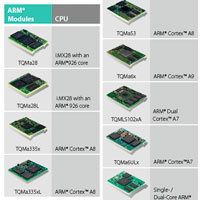
For ARM-based modules, they presented the small but efficient
TQMa6ULx and
TQMa7x modules.
Overall, embedded world was a complete success for TQ Group
again this year. Here is a
small visual retrospective of the trade
fair.
This year, embedded world was able
to celebrate a new record with more than 30,000 attendees. We
are very happy about the great interest in our products and
services and the consistently positive feedback from our
customers.
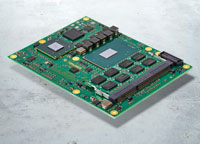
Even more power with the x86: The TQMx60EB with the Intel® "Skylake-H"
TQ focusses on the newest Intel®
Core and Intel® Xeon® processors of the sixth generation
(codename: "Skylake-H"). The COM Express® Basic (Type 6)
TQMx60EB module supports the Intel® i3, i5 and i7 cores of the
6000E series (up to the quad core 3.5 GHz / 8 MB cache) and the
quad core Intel® Xeon E3-1500 v5 processors. The TQMx60EB is
extremely powerful and suited to demanding applications in
medicine, gaming, image processing, automation, simulation and
data analysis.
Development of the new minimodules
based on the i.MX7 and i.MX6UL is coming along nicely and we
will be able to offer an evaluation platform very soon. The
TQMa6ULx is planned for the end of May followed by the TQMa7x,
scheduled for delivery at the end of June.
With these product additions, the TQ Embedded division is
expanding its product portfolio in the ARM area to be
unbeatable.
The new Power Architecture™ TQMT1042 module – First prototypes
available!
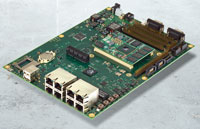
Prototypes of the new QorIQ
TQMT1042 minimodule are now available. It is supplied with the
STKT104X motherboard as an evaluation platform. The quad core
processor used will convince you with its high performance in
computing power, the gigabit Ethernet and additional I/O
interfaces. The Aurora connector available on the motherboard
provides a standardized interface for debugging software and
helps optimize development times and costs.
The flexible module design supports all pin-compatible
processors of the NXP T1/T2 series and also allows simple
scalability within the application.